

You are now leaving our website and entering a third-party website over which we have no control.
Four generations of growing wildly better: How Wyman’s and TD cultivate resilience, community, and one of the world’s healthiest fruits

On a cool Maine morning in early fall, the first trucks of the day rumble down dirt roads toward Wyman’s operations outside the town of Cherryfield, loaded with bins of wild blueberries. This time of year, a ground fog rises from the barrens where generations of families have harvested fruit that grows in abundance in Downeast Maine and in the Canadian Maritimes.
For more than 150 years, Wyman’s has been part of that rhythm—harvesting, freezing, and shipping wild blueberries from its Down East roots to kitchens nationwide. Today, the fourth-generation, family-owned company is led by CEO Tony Shurman and CFO Bob Mancini, who balance a 19th-century legacy with a 21st-century growth plan.
Their long-time bank, TD, has stood beside them for two decades, helping Wyman’s navigate agricultural volatility, cross-border operations, and steady expansion plans. The relationship is built on a simple premise: a trusted connection with shared values can best support the company’s resilience across year-to-year peaks and valleys in harvests and its growth strategy.
Legacy as a growth strategy
Wyman’s story began in 1874 along Maine’s rugged coast. A century and a half later, its heritage is less a marketing line than a core business asset. “Our over 150-year family ownership is a strategic advantage,” says Shurman. “Consumers want to know who’s behind their food—that the land and the people are treated well, and that what they’re eating is genuinely good for them.” The phrase “Family-owned in Maine since 1874” appears on every bag as a promise and proof of the company’s long heritage.
By Shurman’s count, the brand has nearly tripled in size over the past decade and now ranks as the largest brand of frozen fruit in retail US with wild blueberries remaining the hero of Wyman's product line. “We’re de-commoditizing the frozen fruit category through the wild blueberry and its superior story and health benefits,” he says.
Culture and community at the core
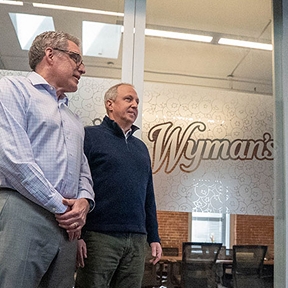
If Wyman’s fruit is wild, its company culture is deliberately cultivated. Two principles—Do the Right Thing and Seek a Better Way—guide decisions from farm practices to employee benefits. “It’s not about quarterly profits,” Mancini says. “Since we’re privately held, we can take the long view. We reward success through profit-sharing and strong benefits. It’s about doing right by the company, our people, and our communities.”
That commitment shows in the numbers. With about 300 team members, Wyman’s average employee tenure is just under ten years, and nearly 30 percent have been with the company more than a decade, and many for over 25 years. “That’s an exceptional retention rate in seasonal agriculture and manufacturing,” says Shurman.
“Some of my proudest moments,” Shurman says, “are watching employees buy their first homes, advance in their careers, and feel part of something bigger than themselves.”
Community investment runs deep at Wyman’s. Twice a year, Wildly Better Days sends employees to volunteer at food banks, neighborhood cleanups, and other events. The company supports the Maine Seacoast Mission to help fund food, housing, and medical programs. And a new Wyman’s Trail initiative is opening portions of company-owned land for public hiking and camping.
Managing volatility with the help of TD
Wyman’s first turned to TD in 2005 to streamline the company’s cross-border banking between its Maine operations and those of its Canadian subsidiary on Prince Edward Island. “We wanted a bank with a global reach and found it with TD,” Mancini recalls.
The relationship soon expanded into every corner of the company’s financial life. For example, TD is the administrative agent on Wyman’s syndicated revolving credit facility, coordinating with three other banks and simplifying drawdowns and capital planning.
Mancini notes that TD has helped Wyman’s manage the financial implications of what can be huge variations in annual harvest volumes. Growing wild fruit is never routine. Yields can swing from 80 million pounds one year to less than 40 million the next, depending on rainfall, pollination, and heat.
With only one annual harvest, each season sets the tone for the next twelve months. “Having a bank that truly understands agricultural volatility is invaluable,” Mancini says. “TD has been on the journey with us for almost twenty years.”
Foreign exchange assistance. Beyond credit, TD handles the company’s foreign-exchange transactions and provides interest-rate swaps that stabilize borrowing costs. Wyman’s also depends on TD’s eTreasury platform for daily payables and liquidity management.
Continuity has been another constant. In two decades, Wyman’s has had only three TD relationship managers. “That kind of stability matters,” Mancini says. “Every new banker means re-educating someone. With TD, they already deeply understand how our business works.” Shurman notes, “We've built a relationship where it’s not just about our balance sheet, it’s TD knowing our people, seeing what we’re building, and believing in our future.”
Open communications. Transparency keeps the relationship strong. “TD is always my second call—right after Tony,” Mancini adds. “If something’s going right or wrong, they know immediately and provide guidance. That’s how we’ve built a trusted relationship over the past 20 years.”
That trust proved essential in 2025, when a record drought and erratic pollination produced one of the smallest crops in decades—just half of 2024’s harvest. Nonetheless, thanks to disciplined planning with the help of TD, Wyman’s financial performance continues to be strong. “That’s the strength of having a genuine and trusted relationship with your bank,“ Mancini says. “They help us manage the valleys so we’re ready for the peaks.”
A “wildly better” future
Asked what “wildly better” success means, Shurman doesn’t hesitate. “Nine out of ten Americans don’t eat enough fruit,” he says. “Our mission is to help close that gap—to make it easier for people to live healthier lives by eating more fruit.”
That purpose drives the company’s next chapter: innovating new products, diversifying beyond blueberries, and protecting the fragile ecosystems that make the crop possible. It also means strengthening the culture that keeps its people—and its communities—thriving. As Shurman sees it, “Our culture is in perfect alignment with what TD stands for and why our two companies are such a good match. We both put people first.”
Mancini reflects on how far Wyman’s has come since its founding. “We started as a sardine company over 150 years ago, and today we’re America’s top frozen-fruit brand. That’s quite a journey.”
For both leaders, TD remains a key part of that journey for Wyman’s —an anchor through uncertainty and a sounding board for what’s next. “Doing the right thing has gotten us this far,” Shurman says. “With the right team beside us, including TD, we’re ready for the next 150.”